
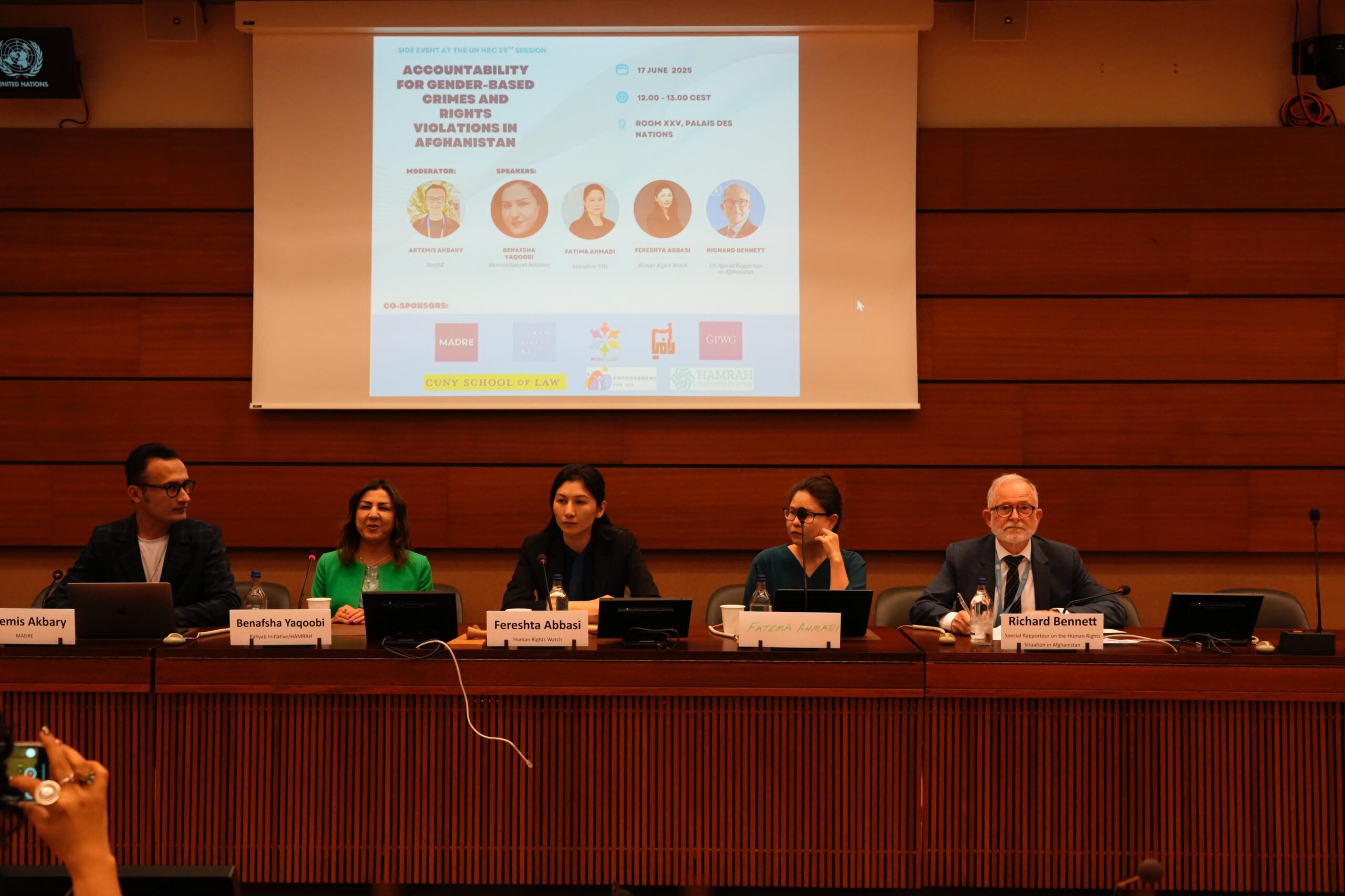
On 17 June 2025, during the 59th session of the UN Human Rights Council in Geneva, the Gender Persecution in Afghanistan Accountability Working Group (GPWG) organized a side event titled “Accountability for Gender-Based Crimes and Rights Violations in Afghanistan.” The event brought together Afghan human rights defenders, civil society representatives, legal experts, and international human rights actors to discuss urgent accountability pathways for gender-based crimes and systematic rights violations under Taliban rule.
Since the Taliban’s return to power in August 2021, Afghanistan has witnessed a severe and systematic rollback of fundamental rights. Women, girls, LGBTIQ+ people, persons with disabilities, and other marginalized communities have been among those most targeted. The Taliban’s policies and practices have denied women and girls access to education, work, freedom of movement, public life, expression, and protection from violence. LGBTIQ+ Afghans continue to face extreme threats to their safety, dignity, and existence.
The event focused on how these violations may amount to international crimes, including the crime against humanity of gender persecution. Speakers also discussed the growing calls from Afghan civil society and international organizations for stronger accountability measures, including the establishment of a complementary international, independent investigative mechanism, potential proceedings before the International Court of Justice, and continued engagement by the International Criminal Court.
The discussion was moderated by Artemis Akbary, representing ALO and GPWG. The panel featured contributions from Richard Bennett, UN Special Rapporteur on the situation of human rights in Afghanistan; Fereshta Abbasi, Afghanistan Researcher at Human Rights Watch; Fatema Ahmadi, from Rawadari; and Banafsha Yaqoobi, founder of the Rahyab Initiative and a long-standing advocate for the rights of women and persons with disabilities.
Panelists highlighted the lived realities of Afghan women, girls, LGBTIQ+ people, and women and girls with disabilities under Taliban rule. They emphasized that accountability efforts must be survivor-centered, intersectional, and inclusive of the communities most affected by Taliban policies. Speakers also underlined the essential role of Afghan civil society, including organizations working in exile and those continuing protection and documentation work inside Afghanistan under extremely difficult conditions.
A central message of the event was that Afghan civil society must be meaningfully included in all international processes concerning Afghanistan’s future. Victims and survivors of grave human rights violations, including gender persecution, must have a voice in political, legal, and diplomatic discussions. Any process that excludes Afghan women, LGBTIQ+ people, persons with disabilities, and other marginalized groups risks reinforcing impunity and further silencing those most affected.
Through this side event, GPWG reaffirmed its commitment to advancing accountability for gender persecution and other gender-based crimes in Afghanistan. The discussion also highlighted the importance of recognizing the experiences of LGBTIQ+ Afghans within broader accountability efforts, ensuring that no community is left behind in the pursuit of justice.
GPWG and its partners call on states, UN bodies, and international institutions to take concrete and coordinated action. This includes supporting Afghan civil society, strengthening documentation of violations, advancing international legal pathways, and ensuring that accountability efforts are inclusive, victim-centered, and responsive to the realities of all affected communities.
The event served as an important platform to amplify Afghan voices and reinforce a shared demand: accountability for gender-based crimes and rights violations in Afghanistan must be urgent, inclusive, and survivor-centered.


