
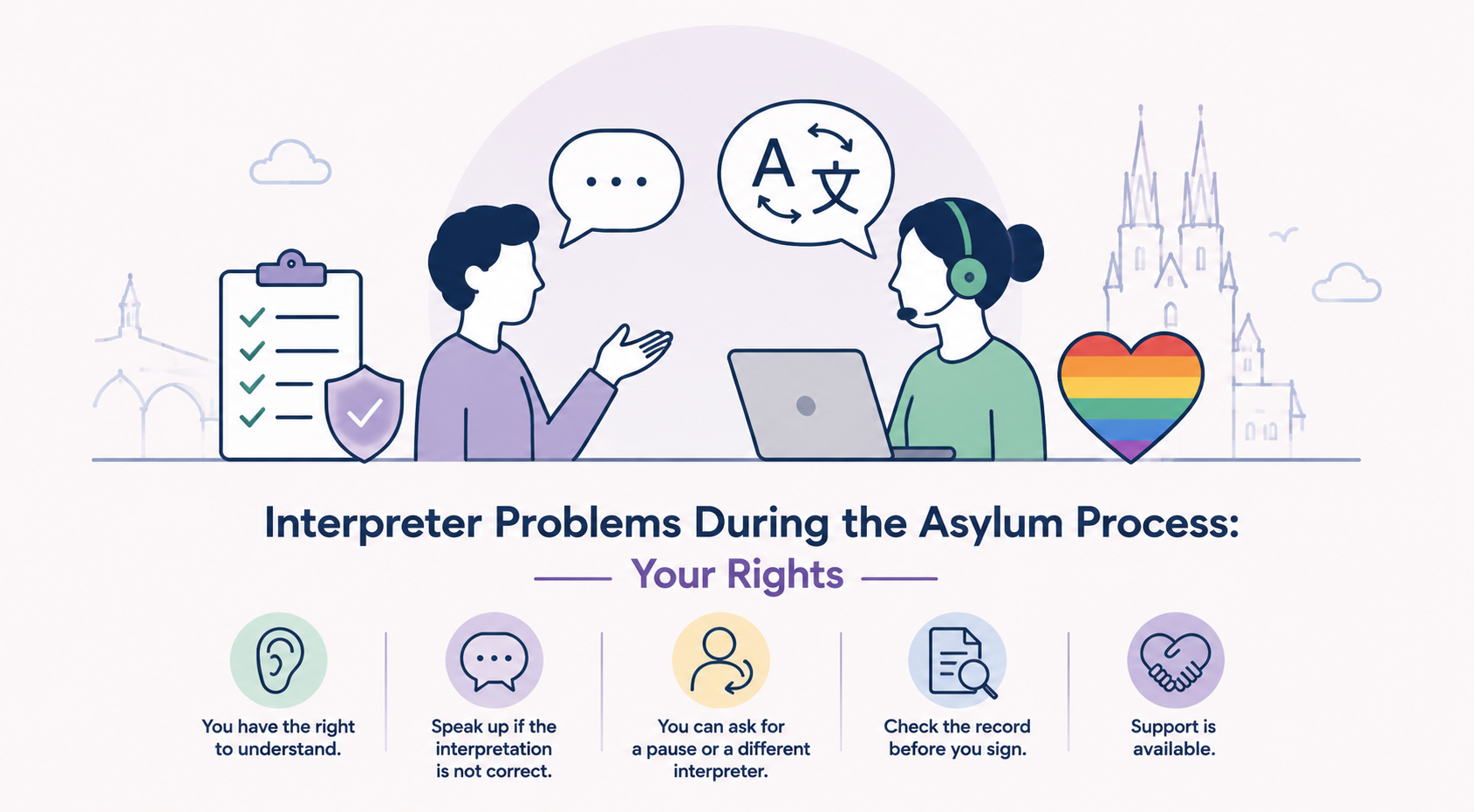
An interpreter can play an important role in your asylum procedure. They help you communicate with officials when you do not speak Czech well enough to understand the questions or explain your experiences fully.
Interpretation problems can seriously affect an asylum application. An interpreter may use the wrong language or dialect, shorten your answers, misunderstand LGBTIQ+ terminology, or make you feel unsafe.
You do not have to remain silent when this happens. You can raise the problem, ask for the interview to be paused, and request support from a lawyer or trusted organisation.
What Is the Interpreter’s Role?
The interpreter should help communication between you and the official conducting the interview.
The interpreter should:
- Translate questions accurately.
- Translate your complete answers.
- Use language that you understand.
- Remain neutral.
- Avoid giving personal opinions.
- Treat you respectfully.
- Protect confidential information learned during the procedure.
- Tell the official when they do not understand a word or expression.
The interpreter is not your lawyer, adviser, friend, or decision-maker. They should not change your answer, tell you what to say, or decide whether your experiences are believable.
Your Rights During Interpretation
You have the right to understand the procedure and communicate your reasons for seeking protection.
You can:
- Say when you do not understand the interpreter.
- Ask for a question to be repeated or explained.
- Correct an inaccurate translation.
- Ask the interpreter to translate your complete answer.
- Request a pause when interpretation problems occur.
- Explain that a particular interpreter creates a safety or confidentiality concern.
- Ask whether another interpreter can be provided.
- Inform your lawyer or a trusted NGO about the problem.
- Ask for errors in the written interview record to be corrected before signing it.
You may also ask in advance for an interpreter of a particular gender when this is important for your safety or ability to discuss sensitive experiences. Such requests may not always be possible to accommodate immediately, but they should be communicated as early as possible.
Language, Dialect, and Nationality Are Not the Same
An interpreter may speak a language related to yours without understanding the particular dialect or vocabulary that you use.
For example, problems may occur when:
- You speak a regional dialect.
- You use terminology from a minority community.
- The interpreter understands the language but not your accent.
- The interpreter uses words that have a different meaning in your country.
- You and the interpreter come from different linguistic communities.
- The interpreter does not understand LGBTIQ+ or SOGIESC terminology.
Do not say that you understand the interpreter when you do not.
You can explain:
“I understand some of the words, but I cannot communicate accurately in this language or dialect.”
A person’s nationality should not automatically determine which language or dialect they understand best.
When an Interpreter May Create a Safety Risk
Speaking about sexual orientation, gender identity, family violence, religion, political activity, or sexual violence can be extremely difficult.
You may not feel safe with an interpreter who:
- Comes from your local community.
- Knows you or your family.
- Has links to people you fear.
- expresses hostile religious or political opinions.
- Uses insulting words about LGBTIQ+ people.
- Has previously disclosed information about other applicants.
- Makes you afraid that your identity will become known in your community.
Explain the concern as clearly as you can. You do not necessarily need to reveal every sensitive detail in front of that interpreter.
You can say:
“I have a serious confidentiality and safety concern about speaking through this interpreter. I would like the interview to be paused so that I can explain the concern privately.”
Signs That the Interpretation May Be Inaccurate
Interpretation problems may occur when:
- Your long answer is translated in only a few words.
- The interpreter speaks for much longer than you did.
- The official’s response does not relate to what you said.
- Important names, dates, locations, or events are changed.
- The interpreter interrupts you repeatedly.
- The interpreter answers questions on your behalf.
- Your words are made stronger or weaker.
- LGBTIQ+ terms are replaced with insulting or inaccurate language.
- The interpreter refuses to use your chosen name or pronouns.
- The interpreter adds opinions or explanations that you did not give.
- The written record contains information you never said.
Not every difference in sentence length proves that the interpretation is wrong. Languages express information differently. However, you should speak up when the meaning of your answer has changed or important information has been omitted.
What to Do During the Interview
Stop and Raise the Problem
Do not wait until the end if an important answer has been translated incorrectly.
You can say:
“That was not what I said. Please allow me to explain my answer again.”
You can also say:
“The interpreter did not translate my complete answer.”
“The word being used is insulting and does not describe my identity.”
“I do not understand this interpreter well enough to continue.”
“I am asking for the interview to be paused.”
Ask for the Problem to Be Recorded
Ask the official to note in the interview record that:
- You reported an interpretation problem.
- You requested a correction.
- You asked for another interpreter.
- Your request was accepted or refused.
- You raised a confidentiality or safety concern.
Having the problem recorded may help your lawyer address it later.
Ask for a Different Interpreter
When the problem is serious, you may ask for another interpreter.
Explain the reason calmly and specifically. For example:
- Wrong language or dialect.
- Inaccurate translation.
- Mockery or discriminatory behaviour.
- Conflict of interest.
- Confidentiality concerns.
- Personal connection to your family or community.
- Inability to discuss traumatic or sensitive experiences safely.
Requesting another interpreter should not be treated as refusing to cooperate with the procedure.
What to Do Before Signing the Interview Record
The written record may be prepared in Czech. Ask for it to be read back or interpreted in a language you understand.
Check carefully:
- Your personal details.
- Names and locations.
- Dates and sequence of events.
- Who harmed or threatened you.
- Why you left your country.
- Why you cannot return.
- Information about your sexual orientation or gender identity.
- Information about family relationships.
- Any statement that appears inconsistent with what you said.
Do not ignore an important mistake because you feel tired or pressured.
Ask for the mistake to be corrected before signing. When a correction is refused, ask for your objection to be added to the record.
Request a copy of the completed record and keep it safely.
What to Do After the Interview
As soon as possible, write down:
- The date, time, and location.
- The interpreter’s name or identification, if known.
- The official’s name or position.
- Which answers were translated incorrectly.
- The words the interpreter used.
- Any mockery, misgendering, or discriminatory remarks.
- Whether you asked for a pause or replacement.
- How the official responded.
- Whether anyone witnessed the incident.
- Which parts of the written record are incorrect.
Send these notes to your lawyer or trusted organisation.
Do not wait until you receive a decision if the interpretation problem could affect the assessment of your application.
A Simple Incident Record
You can use the following structure:
Date and time:
Place:
Type of appointment or interview:
Language requested:
Language provided:
Who was present:
What I said:
How it was interpreted:
Why the interpretation was inaccurate or unsafe:
What I requested:
How the official responded:
Witnesses or supporting evidence:
Keep the record with your asylum documents.
When to Contact a Lawyer Urgently
Seek legal help as soon as possible when:
- You could not understand the interpreter.
- Important parts of your story were omitted or changed.
- The interpreter disclosed or threatened to disclose private information.
- The interpreter mocked, misgendered, or insulted you.
- You were pressured to continue despite a safety concern.
- You were pressured to sign an inaccurate interview record.
- An incorrect interpretation created contradictions in your case.
- You have received a negative decision that relies on statements you did not make.
Key Takeaways
- The interpreter must communicate your meaning, not replace it with their own.
- Say immediately when you do not understand or when your answer is changed.
- You can ask for the interview to be paused.
- You can request a different interpreter when there is a serious language, bias, conflict, or safety problem.
- Check the interview record before signing it.
- Keep detailed notes about interpretation problems.
- Contact a lawyer or trusted organisation quickly when the problem may affect your case.
This article provides general information and does not replace individual legal advice. Procedures may depend on the circumstances of your case. The Czech asylum procedure is governed mainly by the Asylum Act and related administrative and judicial rules.


