
ALO’s Engagement with CEDAW: Advancing Justice for Afghan Women, Girls, and LBTI Communities
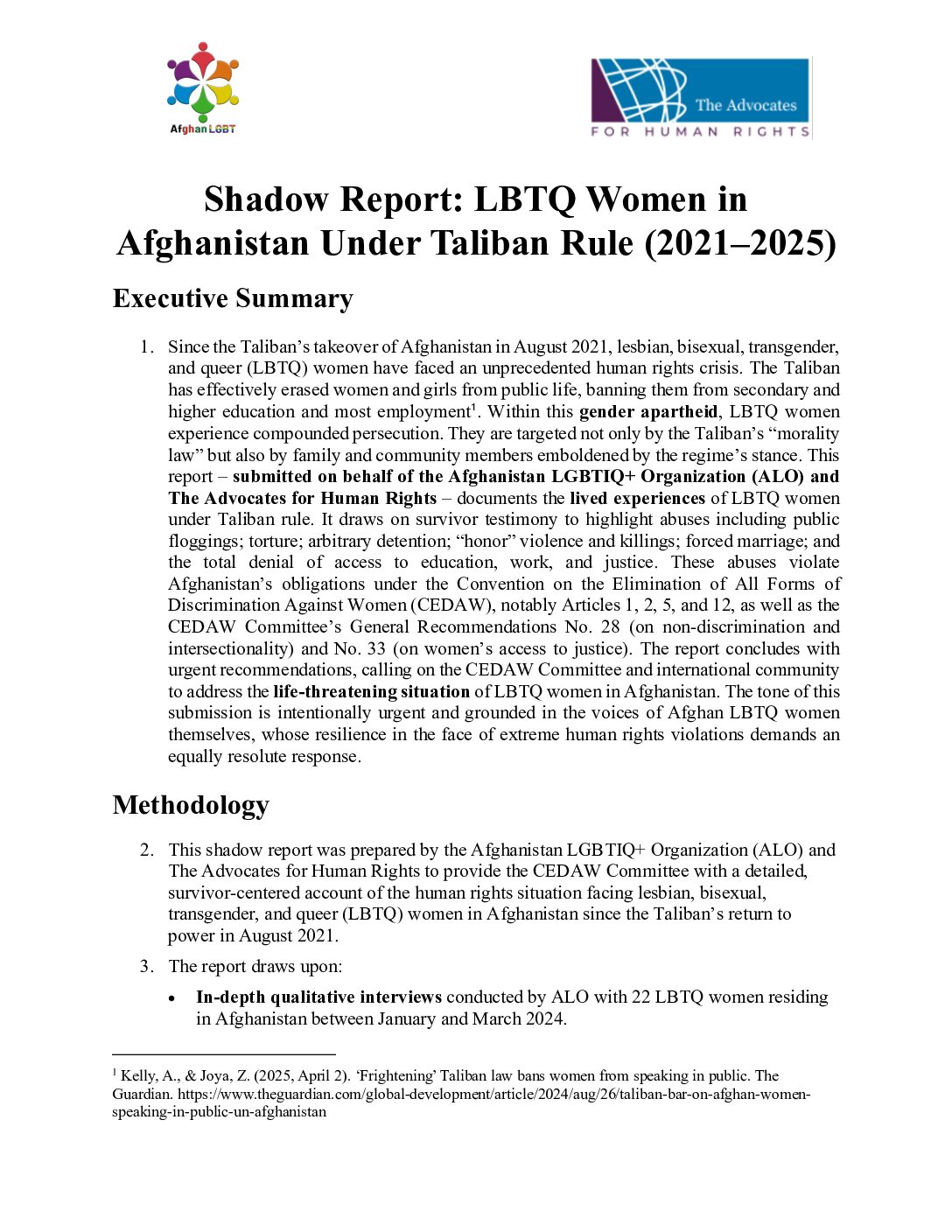
During the 91st Session of the UN Committee on the Elimination of Discrimination Against Women (CEDAW), the Afghanistan LGBTIQ+ Organization (ALO) played a central role in bringing forward evidence of gender persecution, gender apartheid, and the systematic targeting of women, girls, and LBTI individuals under Taliban rule. As part of a civil society delegation, ALO submitted a shadow report documenting widespread abuses and delivered two powerful oral statements that amplified the voices of groups most excluded from international decision-making.
ALO’s participation marked a significant contribution to ensuring that violations affecting LBTI women—often overlooked in international reporting—were recognized as part of the broader pattern of gender-based crimes in Afghanistan. Through evidence, survivor-informed analysis, and coordinated advocacy, ALO and its partners called on the Committee and UN member states to take urgent and comprehensive action.
Aylar Rezaee’s Joint Statement: Exposing the Persecution of LBTI Women
Representing ALO, the Gender Persecution Accountability Working Group (GPWG), and MADRE, Aylar Rezaee delivered a joint statement spotlighting the widespread, systematic persecution of LBTI women and girls. Her intervention detailed grave human rights violations including:
- Forced and child marriage
- Denial of education and employment
- Arbitrary arrest and detention
- Torture and sexual violence
- Punishments linked to gender expression and identity
Aylar emphasized that these abuses constitute crimes against humanity under the framework of gender persecution and urged the CEDAW Committee to explicitly condemn these violations under Articles 1, 2, 5, 12, and 15. The statement called for the repeal of restrictive decrees—including compulsory hijab and mahram rules—the release of detainees imprisoned for their identity or appearance, and the revocation of “vice and virtue” laws criminalizing same-sex relationships. It also urged support for the codification of gender apartheid in international law.
Muzhda Samadi’s Statement: Gender Persecution Across Systems of Oppression
In a separate statement, Muzhda Samadi highlighted the dismantling of rights and protections for women and girls more broadly. She addressed:
- The exclusion of women from governance, the judiciary, and political participation
- The Taliban’s use of mahram and hijab mandates as tools of surveillance and coercion
- The elimination of gender-based violence (GBV) services
- The criminalization of GBV survivors
- Patterns of forced marriage, public flogging, torture, and sexual violence
Muzhda underscored that these actions amount to the crime against humanity of gender persecution, noting that while some violations predate the Taliban, the scale and systemization have sharply intensified. Her calls included ending mahram and hijab enforcement, restoring conditions for inclusive governance, eliminating forced marriages, enabling women lawyers and service providers to assist GBV victims, and ensuring that Afghan women and LGBTIQ+ civil society participate meaningfully in all international processes—including UNAMA and the Doha process.
Collective Advocacy: Confronting Gender Apartheid and Demanding Accountability
Together, ALO delegates worked with Afghan and international partners to ensure the CEDAW Committee heard the voices of the groups most affected by Taliban policies. Their advocacy exposed:
- The systematic control of women through hijab and mahram restrictions
- Torture, public punishments, arbitrary detention, and violence against LBTI individuals
- The exclusion of women and marginalized groups from public life and decision-making
- Criminalization of survivors and the collapse of GBV services
- A pattern of gender persecution and gender apartheid
Key recommendations included demanding the repeal of discriminatory decrees, ensuring the release of detainees, strengthening support for accountability efforts at the ICC, ICJ, and a potential new independent investigative mechanism, and codifying gender apartheid using inclusive definitions that recognize the experiences of LBTI women, girls, and all victims of gender-based oppression.
A Commitment to Centering Marginalized Voices
By submitting a shadow report, delivering impactful oral statements, and engaging directly with UN experts, ALO reaffirmed its commitment to ensuring that LBTI women and girls—those at the intersection of multiple forms of discrimination—are seen, heard, and protected within international human rights systems.
Our work with CEDAW continues to contribute to global recognition of gender-based crimes in Afghanistan and to strengthen international accountability efforts for survivors across the country.


