
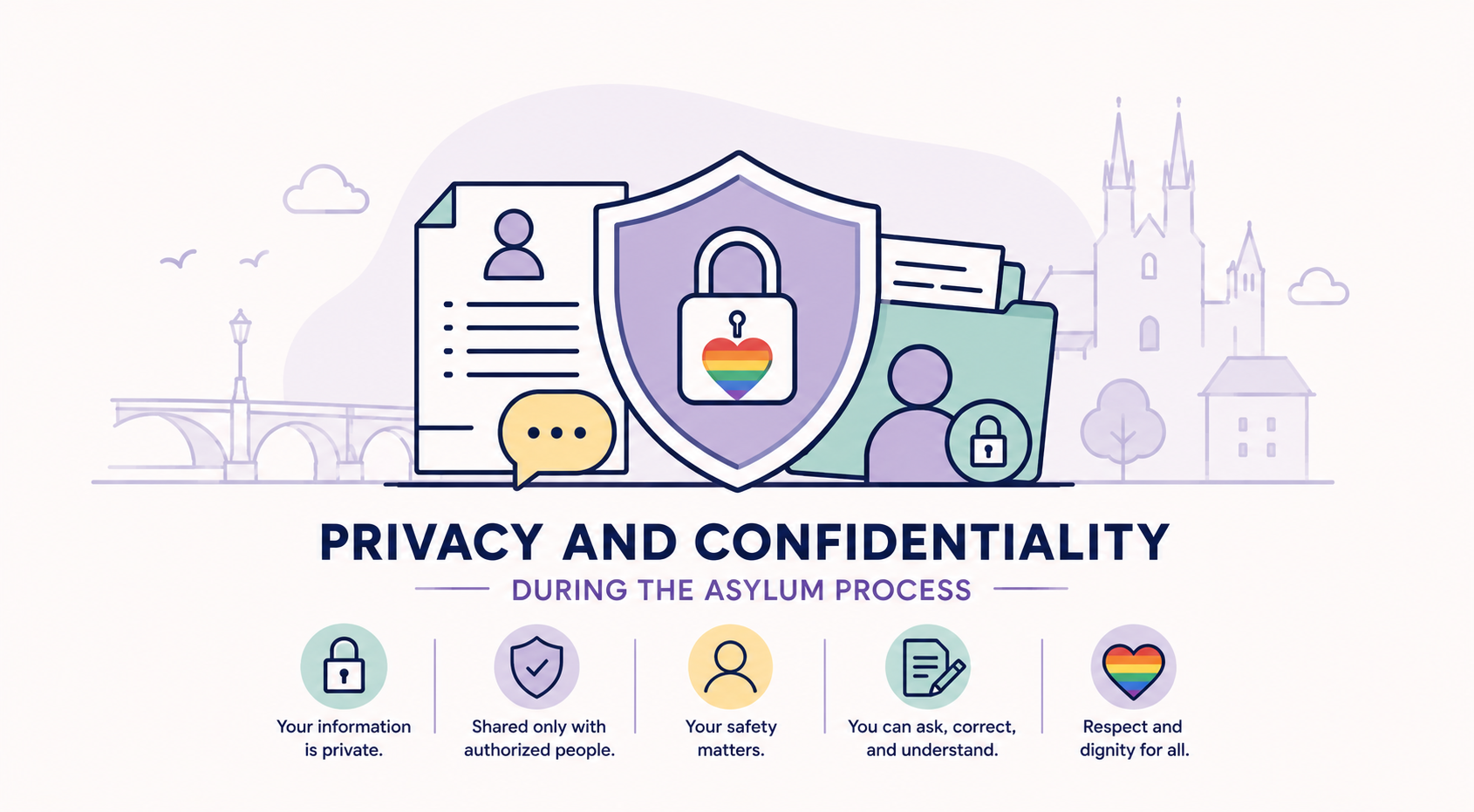
Your asylum application may contain highly sensitive information about your life, family, health, political activities, religion, sexual orientation, gender identity, relationships, or experiences of violence.
This information must be handled carefully. Officials may need to collect and use personal information to examine your application, but they should not disclose it unnecessarily or use it for an unrelated purpose.
For LGBTIQ+ applicants, a privacy breach can create serious risks. It may expose someone to family rejection, community violence, harassment in an accommodation centre, blackmail, or danger to people in their country of origin.
What Does Confidentiality Mean?
Confidentiality means that information shared during your asylum procedure should only be accessed and used by authorised people for legitimate purposes connected to the procedure or another lawful responsibility.
People who may handle parts of your information can include:
- Ministry of the Interior officials.
- Interpreters.
- Courts.
- Lawyers and legal representatives.
- Staff responsible for accommodation or essential services.
- Healthcare professionals.
- Other authorised public bodies where the law permits or requires it.
This does not mean that no one can ever process or share your information. Authorities need certain information to examine your application and perform their legal duties.
However, access should not be wider than necessary, and sensitive information should not be casually disclosed to other residents, community members, employers, relatives, or unauthorised staff.
Information concerning health, sex life, and sexual orientation receives particular protection under EU data-protection law.
Information That May Be Especially Sensitive
Sensitive information may include:
- Sexual orientation.
- Gender identity or expression.
- Sex characteristics.
- HIV status or other health information.
- Mental-health information.
- Experiences of sexual violence.
- Former names.
- Gender-related medical care.
- Religious conversion or beliefs.
- Political activity.
- Family members’ identities or locations.
- Contact details of partners or community members.
- Information about people who helped you escape.
- Photographs, messages, and social media records.
Only provide information that is relevant to your application or requested for a clear lawful purpose. Ask your lawyer when you are unsure why information is needed.
Can Information Be Shared With Your Country of Origin?
Your asylum claim should not be handled in a way that alerts the authorities or other actors in your country of origin that you have requested protection or reveals the reasons for your claim.
This is particularly important when you fear state authorities, security forces, family members, armed groups, or community actors.
Tell your lawyer immediately if you believe information about your application has reached someone in your country of origin.
Do not personally contact an embassy, police authority, or other institution from your country of origin to obtain evidence without first discussing the possible risks with a lawyer.
Privacy During an Asylum Interview
Your interview should take place in conditions that allow you to speak freely and safely.
You can raise concerns when:
- Unnecessary people are present.
- You can be heard from outside the room.
- The interpreter knows you or your community.
- Other residents can see sensitive documents.
- Staff discuss your case in a public area.
- Someone uses a speakerphone where others can hear.
- Your chosen name or private information is announced publicly.
You can ask:
“Who is present, and what is their role?”
“Can we discuss this information in a private room?”
“Who will have access to this information?”
“Why is this information necessary for my case?”
“Please do not discuss my sexual orientation or gender identity where other residents can hear.”
Confidentiality and Interpreters
Interpreters may hear extremely private information. They should not share that information with other people or discuss your case in the community.
A confidentiality concern may exist when the interpreter:
- Knows you or your family.
- Comes from a small community where you may be identified.
- Contacts you privately after an interview.
- Discusses other applicants’ cases.
- Threatens to reveal your identity.
- Shares information with residents or community members.
- Expresses hostility toward LGBTIQ+ people.
- Uses your former name or identity publicly.
Raise the concern immediately with the official conducting the interview and contact your lawyer or trusted organisation.
Information in Reception and Accommodation Centres
Accommodation staff may need some information to arrange services or respond to safety concerns. They do not automatically need to know every detail of your asylum claim.
When requesting safer accommodation, you can describe the risk without telling every staff member your complete history.
For example:
“I face a serious risk of harassment from people in this room. I need to discuss the details privately with the responsible social worker.”
Ask:
- Who will receive the information.
- Whether it will be written in your accommodation file.
- Whether a safer placement can be arranged without publicly revealing your identity.
- How the facility will prevent retaliation.
Chosen Names and Pronouns
You can ask staff, interpreters, lawyers, healthcare workers, and service providers to use your chosen name and pronouns in communication.
Official records may still need to include the legal name and gender marker appearing on your identity documents. A chosen name may not automatically replace the legal name in every government database or formal decision.
However, differences between your legal documents and identity should be discussed privately and respectfully.
You can ask for:
- Your chosen name to be added as a communication preference where possible.
- Staff to avoid calling your former name in public.
- Incorrect factual information to be corrected.
- An explanation of why a legal name must appear on a particular document.
- Support from an NGO when document differences repeatedly expose you to harm.
Your Right to Ask About Your Data
Depending on the information and the system in which it is held, you may be able to ask:
- What personal information is being processed.
- Why it is being processed.
- Who may receive it.
- Whether inaccurate information can be corrected.
- Whether unnecessary information can be removed or its use restricted.
- How to complain about unlawful processing.
These rights can have exceptions or limitations, particularly in official proceedings. A request to erase information does not always mean that an authority must delete it when the law requires the information to be retained.
Data-protection rights commonly include access to personal data and correction of inaccurate data, subject to the applicable legal conditions.
Correcting Inaccurate Information
Incorrect information can affect your asylum procedure and personal safety.
Examples include:
- A wrong name or date of birth.
- An incorrect nationality.
- A statement you did not make.
- An incorrect description of your relationship.
- The wrong pronouns.
- Information attributed to the wrong person.
- Sensitive information placed in an unrelated document.
- A mistranslation in an interview record.
When you find an error:
- Write down exactly where it appears.
- Keep a copy of the document.
- Explain what is wrong.
- State the correct information.
- Ask for the request and response in writing.
- Contact your lawyer when the error concerns the substance of your asylum claim.
Do not alter an official document yourself.
What Is a Privacy Breach?
A privacy breach can happen when personal information is:
- Shared with an unauthorised person.
- Discussed where others can hear.
- Sent to the wrong recipient.
- Left visible in a public area.
- Accessed without a legitimate reason.
- Published online.
- Used to harass, threaten, or blackmail you.
- Disclosed by an interpreter to your community.
- Announced in an accommodation centre.
- Included unnecessarily in correspondence seen by other people.
A privacy breach does not need to happen online. Spoken disclosure can also cause serious harm.
What to Do After a Privacy Breach
Protect Your Immediate Safety
Consider whether the disclosure creates an immediate risk.
You may need to:
- Move away from the person threatening you.
- Ask for a room change or transfer.
- Inform a trusted staff member.
- Contact an NGO or lawyer.
- Call emergency services when there is an immediate threat of violence.
- Change passwords or account-access settings.
Record What Happened
Write down:
- The date and time.
- The location.
- What information was disclosed.
- Who disclosed it.
- Who received or heard it.
- How you learned about the disclosure.
- Any witnesses.
- Messages, screenshots, or other evidence.
- Threats or harm that followed.
Report the Incident
Depending on the situation, you may report it to:
- The responsible official or supervisor.
- Facility management.
- Your lawyer.
- A trusted NGO.
- The Ministry of the Interior.
- The Public Defender of Rights.
- The Office for Personal Data Protection.
- The police, when the incident involves threats, blackmail, stalking, or violence.
The Public Defender of Rights may examine the conduct of public authorities and has responsibilities concerning asylum facilities and places where people are deprived of liberty.
A Simple Privacy-Breach Record
Date and time:
Place:
Information disclosed:
Person who disclosed it:
People who received or heard it:
How I discovered the disclosure:
Immediate safety consequences:
Witnesses:
Evidence saved:
Person or organisation notified:
Action requested:
Response received:
Digital Privacy
When using your phone, email, or social media:
- Use a strong password.
- Activate two-factor authentication where possible.
- Review which devices are logged into your accounts.
- Avoid sharing passwords with interpreters or officials.
- Do not send intimate photographs as proof of your identity.
- Remove unnecessary information about other people before submitting screenshots.
- Keep copies of digital evidence that you submit.
- Ask why access to a device or account is being requested.
- Seek legal advice before providing broad access to private accounts.
Do not secretly record an interview without first obtaining legal advice about whether recording is permitted and how it may affect your procedure.
When to Contact a Lawyer Urgently
Seek legal help promptly when:
- Your LGBTIQ+ identity has been disclosed without permission.
- Information has reached your family or community.
- An interpreter has shared information from your interview.
- Sensitive information has been sent to the wrong person.
- An incorrect record affects your asylum claim.
- You face threats, blackmail, or violence following a disclosure.
- You are being pressured to provide unnecessary intimate information.
- You do not understand who is requesting your data or why.
- An authority refuses to address a serious privacy or safety concern.
Key Takeaways
- Authorities may need to process personal information, but they should protect it and use it only for lawful purposes.
- Sexual orientation and health information are particularly sensitive.
- Ask who will access your information and why it is needed.
- Raise privacy concerns before discussing sensitive experiences.
- Record and report unauthorised disclosures.
- Ask for inaccurate information to be corrected.
- Protect other people when submitting messages, photographs, or digital evidence.
- Contact a lawyer or trusted organisation when a breach affects your safety or asylum claim.
This article provides general information and does not replace individual legal or data-protection advice. The exact rights and available procedures depend on who holds the information, why it is processed, and the applicable legal rules.


